Search This Blog

Showing posts with label AVID. Show all posts

11 September 2015

Pre-Activity for Night by Elie Wiesel

We are preparing the read Elie Wiesel's memoir Night. The novel depicts his time in the Nazi German concentration camp.

Part of our literary journey will be to analyze how ignoring a belittling joke can eventually lead to genocide. It is hard concept to imagine that ignoring a joke can lead to such drastic events, but it does happen.

Examples of belittling jokes and stereotypes

The first thing that one should familiarize themselves with the various forms of prejudice that exist in the world. It is far more than race and sexual orientation (a primary focus in the current landscape of American culture). 
Survivors of Buchenwald Concentration Camp
1. Go to Most Common Prejudice. After reading the list and 
description of the various forms of prejudice, create 
Cornell Notes for each type. Include questions that can be used for a Socratic Seminar. 

2. Familiarize yourself with the history of genocide so that you may have a full historical understanding and the background knowledge needed for an analysis. There are two sites that you should read and add to your Cornell Notes: 8 Stages of Genocide and 10 Atrocious Genocides In Human History


3. Although The Pyramid of Hate was discussed thoroughly in class, resources for personal research and growth can be found at The Southern Povery Law Center (a group focused on fighting hate and teaching tolerance in the United States) and The Anti-Defamtion League (a group that was orginally formed to fight against the defamation of Jewish people, but has grown to fight many forms of discrimination and hate). 
The Hate Map on The Souther Poverty Law Center website tracks various hate groups throughout the country. 


4. We began creating Cornell Notes over Oprah's interview with Elie Wiesel at Auschwitz Concentration Camp. You can find videos 1-6 at Winfrey and Wiesel - Auschwitz

5. Read and try to retain the information found at  26 Holocaust Facts for easier comprehension of Night by Elie Wiesel.


03 September 2015

"The Masque of the Red Death" and Close Reading

I love Edgar Allan Poe. 


These darlings of mine represent the poem that I so love.


It could possibly be the macabre and disconsolate tone that every teen (especially those of us from the "grunge" era) finds intriguing. I was completely hooked after an "Annabel Lee" reading.  

As I grew as a person and a reader, I went through a phase in which I found the American Romanantic Movement and anything remotely Gothic to be a trite interest of my teen years.

Yet, here I am professing my love again; this time as a 36 year woman. As I began to teach Poe in my 9th and 10th grade classes, I found craftmanship and slight nuances that a younger version of myself was not able to detect.

There is always "Annabel Lee" to remind me that with its sing-song rhyme, there is so much more depth to a piece when you truly analyze it.


Poe's "Annabel Lee" as read by Matthew Grey Gubler  


Prior to reading "The Masque of the Red Death" by Poe (a 10th grade requirement for my district), I taught the close reading strategies of Marking the Text and Annotating the Text. You can locate this information at Close Reading Strategies

To reinforce the skills and to assist my students in understanding how to read a dense text, I did two things. I combine Cornell Notes, the story, and higher level thinking questions into one document. You can find the free PDF here: "The Masque of the Red Death" Cornell Notes PDF. If you would like one to modify, you can find it here: https:"The Masque of the Red Death" Cornell Notes Word


Initially, the students did independent work using the basics of Marking the Text: 

1. Number the paragraphs
2. Circle important words
3. Underline essential information 
4. Square and define unknown words

We used the Smart Board to truly dive into the text as part of a whole class activity. 

This is an example of the work that we did. Aside from the basic requirements, annotating is an individual journey. 
As we continue to "work the text" in the upcoming days, the students will focus on symbolism, imagery, and theme before writing a literary analysis. 

Learn and Love Loudly!!!

I almost forgot two things: 

1. For students that require audio, I prefer above reading of the text above by Gabriel Bryne. 

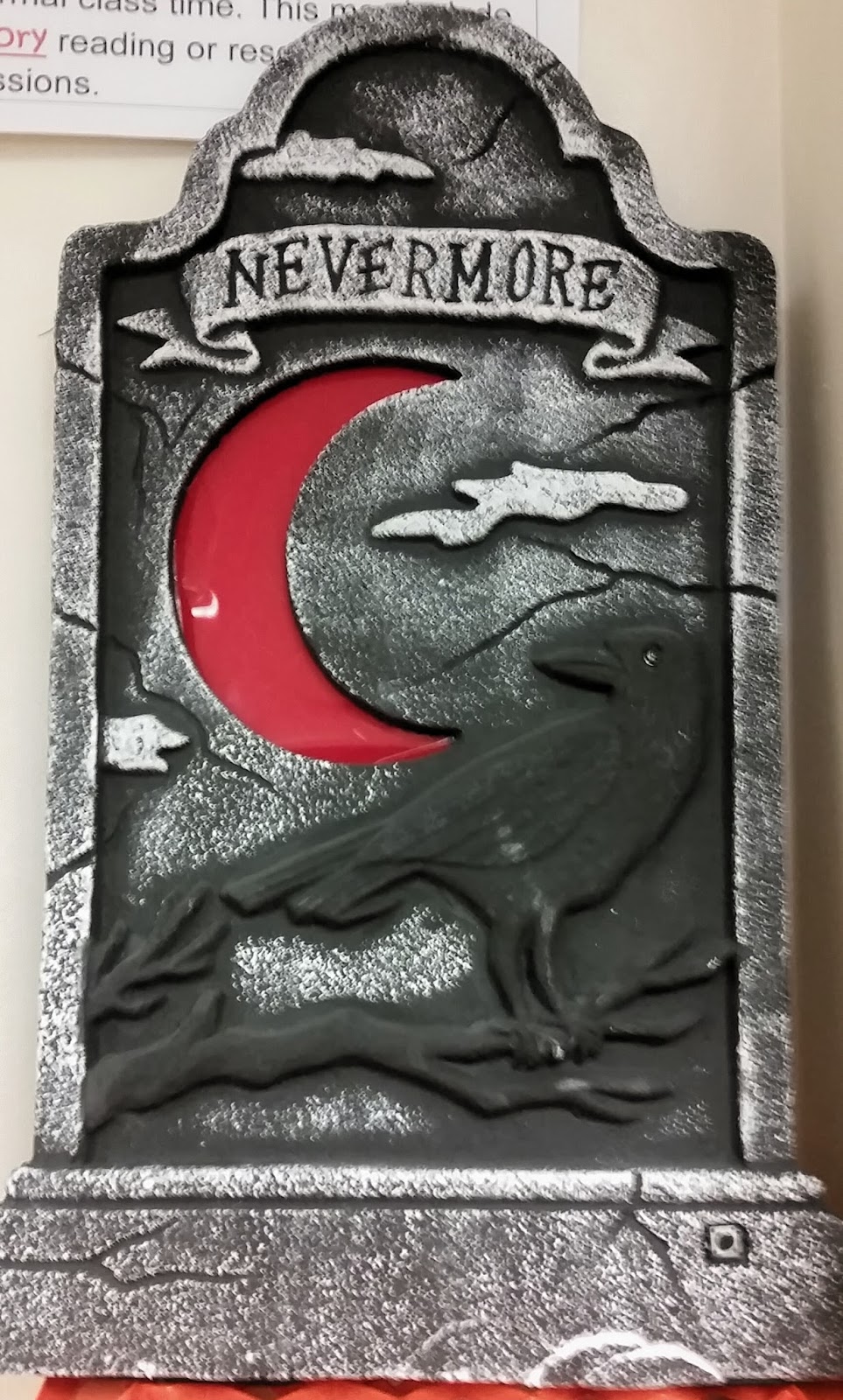
2. I was once told to remove the "satanic decor" from my room because of the item shown below. I had to explain that it was a representations of Poe's most famouse poem "The Raven".


21 August 2015

Close Reading Strategies

1. Skim the Text

Take the time to make note of the author, the title, and any other information that "pops" out of the text. 

2. Marking the Text

  1. Number each paragraph, even if it is a one line paragraph.
  2. Circle key terms
    1. Repeated words
    2. Topic related terms
    3. Key Terms
    4. Bold or Italicized
    5. Words or phrases that are in quotes
    6. Words that have a definition/context clue
  3. Underline claims and essential information
  4. Place a ? by words or ideas that you do not understand. 

3. Examine the Reading Prompt

A reading prompt may not be given with each text, but you will get them often in my class. 

4. Annotating the Text 

Basically, it is a deeper examination of the text from the previous step of Marking the Text. 

This still isn't perfect, but it is better
than the other one. 

This is overdoing it. 

Ways to Annotate

  • Write on the text. 
  • Use Post-It Notes on the text. 
  • Create Cornell Notes.
  • Utilize any graphic organizer that is provided for you.
  • Develop a timeline and/or plot diagram.
  • Use various colored Post-It Notes to track different characters. 
  • Summarize information from chunks of the text. 

I Should Annotate When...

...something grabs my attention. 
...something connects to the theme. 
...powerful literary devices are used. 
...dialogue reveals plot progressions and characterization.