I love Edgar Allan Poe.

 |
| These darlings of mine represent the poem that I so love. |
It could possibly be the macabre and disconsolate tone that every teen (especially those of us from the "grunge" era) finds intriguing. I was completely hooked after an "Annabel Lee" reading.
As I grew as a person and a reader, I went through a phase in which I found the American Romanantic Movement and anything remotely Gothic to be a trite interest of my teen years.
Yet, here I am professing my love again; this time as a 36 year woman. As I began to teach Poe in my 9th and 10th grade classes, I found craftmanship and slight nuances that a younger version of myself was not able to detect.
There is always "Annabel Lee" to remind me that with its sing-song rhyme, there is so much more depth to a piece when you truly analyze it.
Poe's "Annabel Lee" as read by Matthew Grey Gubler
Prior to reading "The Masque of the Red Death" by Poe (a 10th grade requirement for my district), I taught the close reading strategies of Marking the Text and Annotating the Text. You can locate this information at Close Reading Strategies.
To reinforce the skills and to assist my students in understanding how to read a dense text, I did two things. I combine Cornell Notes, the story, and higher level thinking questions into one document. You can find the free PDF here: "The Masque of the Red Death" Cornell Notes PDF. If you would like one to modify, you can find it here: https:"The Masque of the Red Death" Cornell Notes Word.
Initially, the students did independent work using the basics of Marking the Text:
1. Number the paragraphs
2. Circle important words
3. Underline essential information
4. Square and define unknown words
We used the Smart Board to truly dive into the text as part of a whole class activity.
 |
| This is an example of the work that we did. Aside from the basic requirements, annotating is an individual journey. |
Learn and Love Loudly!!!
I almost forgot two things:
1. For students that require audio, I prefer above reading of the text above by Gabriel Bryne.
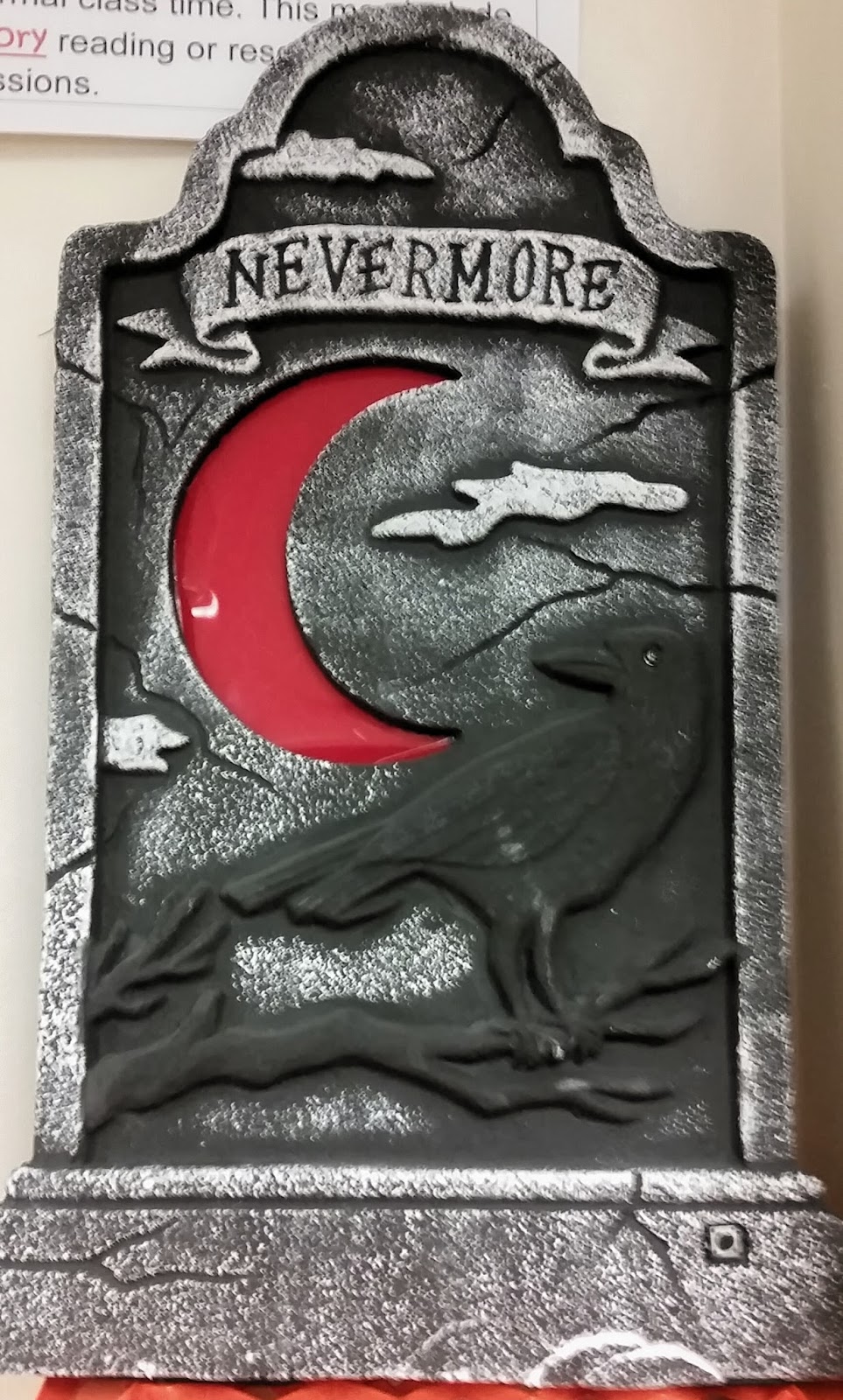 2. I was once told to remove the "satanic decor" from my room because of the item shown below. I had to explain that it was a representations of Poe's most famouse poem "The Raven".


