Search This Blog

Showing posts with label Cornell Notes. Show all posts

11 September 2015

Pre-Activity for Night by Elie Wiesel

We are preparing the read Elie Wiesel's memoir Night. The novel depicts his time in the Nazi German concentration camp.

Part of our literary journey will be to analyze how ignoring a belittling joke can eventually lead to genocide. It is hard concept to imagine that ignoring a joke can lead to such drastic events, but it does happen.

Examples of belittling jokes and stereotypes

The first thing that one should familiarize themselves with the various forms of prejudice that exist in the world. It is far more than race and sexual orientation (a primary focus in the current landscape of American culture). 
Survivors of Buchenwald Concentration Camp
1. Go to Most Common Prejudice. After reading the list and 
description of the various forms of prejudice, create 
Cornell Notes for each type. Include questions that can be used for a Socratic Seminar. 

2. Familiarize yourself with the history of genocide so that you may have a full historical understanding and the background knowledge needed for an analysis. There are two sites that you should read and add to your Cornell Notes: 8 Stages of Genocide and 10 Atrocious Genocides In Human History


3. Although The Pyramid of Hate was discussed thoroughly in class, resources for personal research and growth can be found at The Southern Povery Law Center (a group focused on fighting hate and teaching tolerance in the United States) and The Anti-Defamtion League (a group that was orginally formed to fight against the defamation of Jewish people, but has grown to fight many forms of discrimination and hate). 
The Hate Map on The Souther Poverty Law Center website tracks various hate groups throughout the country. 


4. We began creating Cornell Notes over Oprah's interview with Elie Wiesel at Auschwitz Concentration Camp. You can find videos 1-6 at Winfrey and Wiesel - Auschwitz

5. Read and try to retain the information found at  26 Holocaust Facts for easier comprehension of Night by Elie Wiesel.


03 September 2015

"The Masque of the Red Death" and Close Reading

I love Edgar Allan Poe. 


These darlings of mine represent the poem that I so love.


It could possibly be the macabre and disconsolate tone that every teen (especially those of us from the "grunge" era) finds intriguing. I was completely hooked after an "Annabel Lee" reading.  

As I grew as a person and a reader, I went through a phase in which I found the American Romanantic Movement and anything remotely Gothic to be a trite interest of my teen years.

Yet, here I am professing my love again; this time as a 36 year woman. As I began to teach Poe in my 9th and 10th grade classes, I found craftmanship and slight nuances that a younger version of myself was not able to detect.

There is always "Annabel Lee" to remind me that with its sing-song rhyme, there is so much more depth to a piece when you truly analyze it.


Poe's "Annabel Lee" as read by Matthew Grey Gubler  


Prior to reading "The Masque of the Red Death" by Poe (a 10th grade requirement for my district), I taught the close reading strategies of Marking the Text and Annotating the Text. You can locate this information at Close Reading Strategies

To reinforce the skills and to assist my students in understanding how to read a dense text, I did two things. I combine Cornell Notes, the story, and higher level thinking questions into one document. You can find the free PDF here: "The Masque of the Red Death" Cornell Notes PDF. If you would like one to modify, you can find it here: https:"The Masque of the Red Death" Cornell Notes Word


Initially, the students did independent work using the basics of Marking the Text: 

1. Number the paragraphs
2. Circle important words
3. Underline essential information 
4. Square and define unknown words

We used the Smart Board to truly dive into the text as part of a whole class activity. 

This is an example of the work that we did. Aside from the basic requirements, annotating is an individual journey. 
As we continue to "work the text" in the upcoming days, the students will focus on symbolism, imagery, and theme before writing a literary analysis. 

Learn and Love Loudly!!!

I almost forgot two things: 

1. For students that require audio, I prefer above reading of the text above by Gabriel Bryne. 

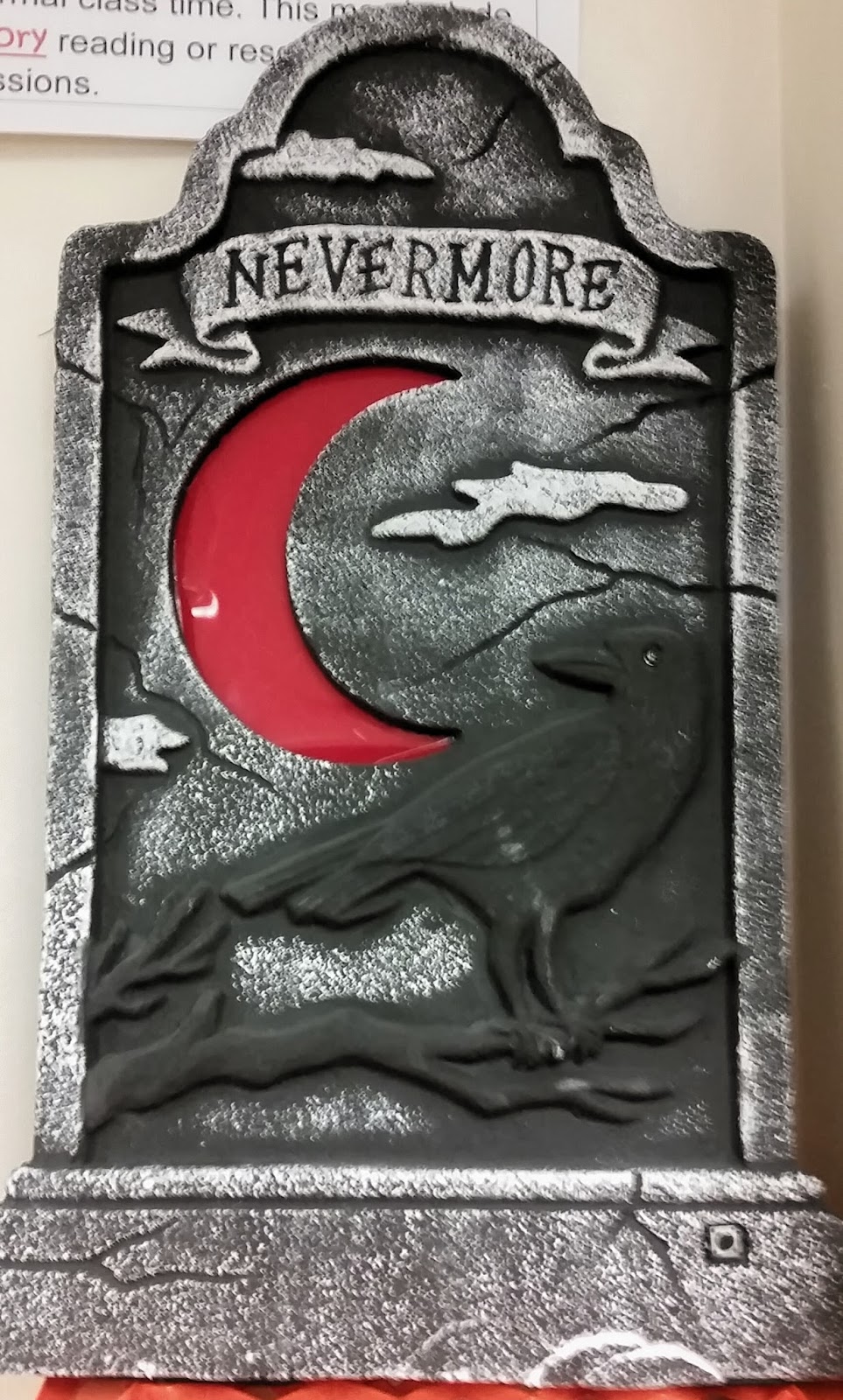
2. I was once told to remove the "satanic decor" from my room because of the item shown below. I had to explain that it was a representations of Poe's most famouse poem "The Raven".


21 August 2015

Close Reading Strategies

1. Skim the Text

Take the time to make note of the author, the title, and any other information that "pops" out of the text. 

2. Marking the Text

  1. Number each paragraph, even if it is a one line paragraph.
  2. Circle key terms
    1. Repeated words
    2. Topic related terms
    3. Key Terms
    4. Bold or Italicized
    5. Words or phrases that are in quotes
    6. Words that have a definition/context clue
  3. Underline claims and essential information
  4. Place a ? by words or ideas that you do not understand. 

3. Examine the Reading Prompt

A reading prompt may not be given with each text, but you will get them often in my class. 

4. Annotating the Text 

Basically, it is a deeper examination of the text from the previous step of Marking the Text. 

This still isn't perfect, but it is better
than the other one. 

This is overdoing it. 

Ways to Annotate

  • Write on the text. 
  • Use Post-It Notes on the text. 
  • Create Cornell Notes.
  • Utilize any graphic organizer that is provided for you.
  • Develop a timeline and/or plot diagram.
  • Use various colored Post-It Notes to track different characters. 
  • Summarize information from chunks of the text. 

I Should Annotate When...

...something grabs my attention. 
...something connects to the theme. 
...powerful literary devices are used. 
...dialogue reveals plot progressions and characterization. 


11 May 2015

The Prince by Machiavelli:Graphic Organizer/Socratic Seminar

Graphic Organizer/Socratic Seminar

The Prince has proven to be a very difficult text for many of my students.

However, through various interpretations, real world connections, discussions, and using a wide range of close reading strategies,

One very successful lesson that aided in comprehension, application, and analysis including a graphic organizer and a pre-write.

In the lesson prior to this one, I had my students generate 5 higher order thinking questions as an exit slip for the following topics:

1. The Prince by Niccolo' Machiavelli
2. Julius Caesar by William Shakespeare
3. Current political/police state of affairs
4. A comparison between The Prince and Julius Caesar
5. A comparison between The Prince and current political/police state of affairs.

Before the day of the Socratic Seminar, I had selected a handful of questions from various students and embedded the questions into a graphic organizer. Because I have so many students in need of differentiated instruction it benefits many of my students to have peer examples and an opportunity to organize their thoughts prior to the lesson. Below is the graphic organizer that I used as a Bell Ringer/Do Now:

Graphic Organizer


CORNELL NOTES

SHEET


 Name: ________________________________________
Class:  ______________________     Topic:  ________________________
Date:   _______/ _____/ ________                                         
Period ______                  

QUESTIONS

NOTES

Discuss whether it is better to be feared or loved when you are a position of power.           ~ Ezequiel S.


Determine the ways that Machiavelli’s theories about how to be a strong ruler is still present in today’s society?      ~ Kelvin W.


Julius Caesar was loved by the people, but hated by the Senate. Explain why and connect the Senate’s actions to statements made in The Prince.
~ Maddlyn H.


Identify examples of how police officers are considered to be Machiavellian through their actions in our society.
~ Alexis B.


Analyze how the current policy systems and government policies are like the principalities described in The Prince.
~ Landon A.


It is common knowledge that Tupac was heavily influenced by The Prince. Infer why this type of text would have such a huge influence on a person hundreds of years later. Discuss whether you believe that Tupac truly identified with the text or if he used Machiavelli to simply gain attention.
 ~ Kyle D.


Generate your own higher order thinking discussion point for this seminar.

SUMMARY:  Write 4 or more sentences describing specific learning from these notes.
__________________________________________________________________________________________
__________________________________________________________________________________________
__________________________________________________________________________________________
__________________________________________________________________________________________
__________________________________________________________________________________________

STUDENT REFELCTION:  Write 4 or more sentences describing what you enjoyed about the lesson and how you believe the lesson could be improved in the future. __________________________________________________________________________________________
__________________________________________________________________________________________
__________________________________________________________________________________________
__________________________________________________________________________________________
__________________________________________________________________________________________


For further help in understand how this was used in my class discussion and as an assessessment piece, here is my lesson plan from that day. 


Socratic Seminar for The Prince and Julius Caesar

English II (Pre-AP)/English II (ESL/Repeaters)


Goals, Objectives, and Standards:

Goals: Students will conduct an academically advanced, collaborative discussion that generates ideas instead of asserting opinions.

Objective: Through a Socratic Seminar, students will be able to gain a deeper understanding of The Prince by Niccolo’ Machiavelli (through chapter 10) and Julius Caesar by William Shakespeare through discussion in a student-run/student-based method of instruction.  Students will answer both interpretive and evaluative questions concerning important issues in the novel and the drama while making real life connections.

C.C.S.S.:

CCSS.ELA-LITERACY.SL.9-10.1.C
Propel conversations by posing and responding to questions that relate the current discussion to broader themes or larger ideas; actively incorporate others into the discussion; and clarify, verify, or challenge ideas and conclusions.
CCSS.ELA-LITERACY.SL.9-10.1.D
Respond thoughtfully to diverse perspectives, summarize points of agreement and disagreement, and, when warranted, qualify or justify their own views and understanding and make new connections in light of the evidence and reasoning presented.

Activities, Tasks, and Methods

Do Now:   Students will review a sample of discussion points and create a list of points that they want to have evaluated/discussed amongst the group using a graphic organizer (Cornell notes).

*ESL/Repeater Modifications (if needed): The teacher will monitor understand and hold mini-discussions while using examples to help students recall and apply the information that was previously learned.

Opening: The teacher will review expectations for listening and responding to one another in a Socratic Seminar.  

*ESL/Repeater Modifications (if needed): The teacher will review the expectations for contributions and show a video that models Socratic Seminar to the students for standards of behavior:  https://www.youtube.com/watch?v=QxZMGK6IdEs


Work Period:

Whole Group:  Students will engage in a Socratic Seminar to develop further understanding of the texts.

Task: The teacher will monitor for academically appropriate discourse between students. The teacher will facilitate the lesson while aiming for a student-led lesson.

Closing: Students will complete the summary and reflection piece on their graphic organizer (Cornell Notes).

Assessment, Grouping and Questioning:  

Assessment: Students will be assessed by contribution to the discussion, which will be evident through respectful and well-processed questions and responses. Students will also provide documentation of their thought-process through their additions to the graphic organizer.

Grouping:  The students will be in a whole-group setting in order to achieve the desired environment for a Socratic Seminar.

Questioning:  Most questions are/will be student-generated (developed prior to class and through discussion); however, the initial question will be:

Considering Machiavelli’s points about a strong ruler, discuss whether it is better to be feared or loved when you are a position of power.

Additional Student Generated Questions Designed for the Purpose of Discussion
1.      Determine the ways that Machiavelli’s theories about how to be a strong ruler is still present in today’s society? ~ Kelvin W.
2.      Julius Caesar was loved by the people, but hated by the Senate. Explain why and connect the Senate’s actions to statements made in The Prince. ~ Maddlyn H.
3.      Identify examples of how police officers are considered to be Machiavellian through their actions in our society. ~ Alexis B.
4.      Analyze how the current policy systems and government policies are like the principalities described in The Prince. ~ Landon A.
5.      It is common knowledge that Tupac was heavily influenced by The Prince. Infer why this type of text would have such a huge influence on a person hundreds of years later. Discuss whether you believe that Tupac truly identified with the text or if he used Machiavelli to simply gain attention. ~ Kyle D.

Homework:

N/A (students are preparing for standardized testing)

Materials and Resources:

Notes on The Prince by Niccolo’ Machiavelli
Notes on Julius Caesar by William Shakespeare
Cornell Notes/Graphic Organizer

Modifications:

Preferential seating

ESL Strategies
·         Extended time
·         Translation Dictionaries
·         Additional Support (as embedded within the lesson)

Until Next Time, 


LEARN LOUDLY!!!


P.S. Don't forget about Tupac


25 November 2014

Introduction to Fahrenheit 451 by Ray Bradbury

 Introduction to Fahrenheit 451 by Ray Bradbury


The second quarter began with Fahrenheit 451 by Ray Bradbury. Aside from a deeply-rooted “geeky” personality, I became very eager to explore censorship, government control, and general dystopian ideas with my students. 

Pop culture is exploding with dystopic teen fiction and movies currently, so I knew the building interest would be easier than with other novels that I have taught over the course of my career.

Banned Books

My very first activity coincided with Banned Books Week. There is a plethora of resources for information on banning books, but I choose to use  Banned  Books Week


I am fortunate enough to have computers in my classroom, so I allowed the students to make a collaborative mini-inquiry project. After the students had been assigned to their small groups, they began to do research on their individual parts: Banned Books that Shaped AmericaMapping CensorshipHeroes and Highlighting Censorship: Tucson Unified School District

After obtaining their individual information, the students determine the method in which they want it presented to the class. Their options are a formal speech, a visual project presentation, or a PowerPoint/Prezi presentation.

Short Stories

Prior to beginning the main focus of a unit, I use short stories to reinforce literary analysis and the examination of elements of fiction. I use stories with similar themes to build text-to-text connection and the ability to identify and argue theme. 


This is the sample
that is on the right side
of the bulletin
board. 
I used “The Pedestrian”  by Ray Bradbury and “Harrison Bergeron” by Kurt Vonnegut, Jr. Both stories work well to demonstrate a dystopian society that is maintained through an oppressive government and technology.  I have my students annotate their text and write a brief analysis with each piece that we read. After the selection and individual work is done, we hold a Socratic seminar regarding the topics and questions generated.


These two pieces work very well for a comparison essay. You can utilize a Venn diagram, Cornell Notes, a bubble map or a 3-sectioned T-chart. I allow my students to choose whichever strategy works before for their pre-writing process. This works well for different learning styles and gives them ownership of their creation.

Twilight Zone

Most people are visual learners and our current students have been raised on technology. Incorporating an old T.V. show does a couple of things: it shows universal theme and how far we have progressed.

“Time Enough at Last”  maintains the loss of knowledge by way of discarding books. Upon completion of the show, I have the students review various pieces of art and propraganda. In small groups, the students must compare the video to one of the visual representations of book burning and will create claims based on the standard (student-generated prompt). The students will use poster-size chart paper to create a visual aid to represent their thoughts. The students will participate in a Gallery Walk, making notes of strengths and weaknesses on each poster with Post-its.


 Fahrenheit 451 by Ray Bradbury 

I work in an urban school with a high poverty rate. This makes at-home reading difficult because we have a shortage of books and a lack of technology in the students’ homes. Therefore, we do our reading in class.

I start the class with a Do Now/Bell Ringer that pertains to the subject matter or a reflective writing prompt about the previous reading. This is especially easy at this time due to current events worldwide.

Next, I spend a small portion of my time providing instruction and information. We also address any areas of concern and commentary.

After reading the selection in their small groups, the students work collaboratively on their graphic organizer. These snapshots are from my smart book; for the download go to Dialectical Journal: Literature Circle Activities

 I have the students recreate the graphic organizer in their journal. This one in particular is a combination of a dialectical journal, Cornell notes, and Literature Circles. The students are able to work collaboratively while providing individual work and avoiding the argument of how much their partners are contributing.


Common Core State Standards Used

CCSS.ELA-LITERACY.W.9-10.1
CCSS.ELA-LITERACY.W.9-10.2
CCSS.ELA-LITERACY.SL.9-10.4
CCSS.ELA-LITERACY.SL.9-10.5
CCSS.ELA-LITERACY.RL.9-10.1
CCSS.ELA-LITERACY.RL.9-10.2
CCSS.ELA-LITERACY.RL.9-10.3
CCSS.ELA-LITERACY.RL.9-10.4
CCSS.ELA-LITERACY.RL.9-10.5
CCSS.ELA-LITERACY.RL.9-10.7

Until Next Time,

Learn LOUDLY!!!


P.S. If you enjoy using lyrics as poetry and are looking for connections, Lit Tunes offers the following suggestions:


  • "In the Year 2525" by Zeger and Evans Summer of Peace Love and Music
  • "Choose Your Own Perfume" by Chris Hawkins SIBL Contest Winners                       
  • “Conformity 451" by Norine Braun SIBL Contest Winners                                
  • "Let Down" by Radiohead OK Computer               
  • "Fahrenheit 451" by Utopia Swing to the Right  
  • “The Sound of Silence" by Simon and Garfunkel Wednesday Morning, 3 AM